Emergency Fund vs Paying Down Debt: What Should Come First?
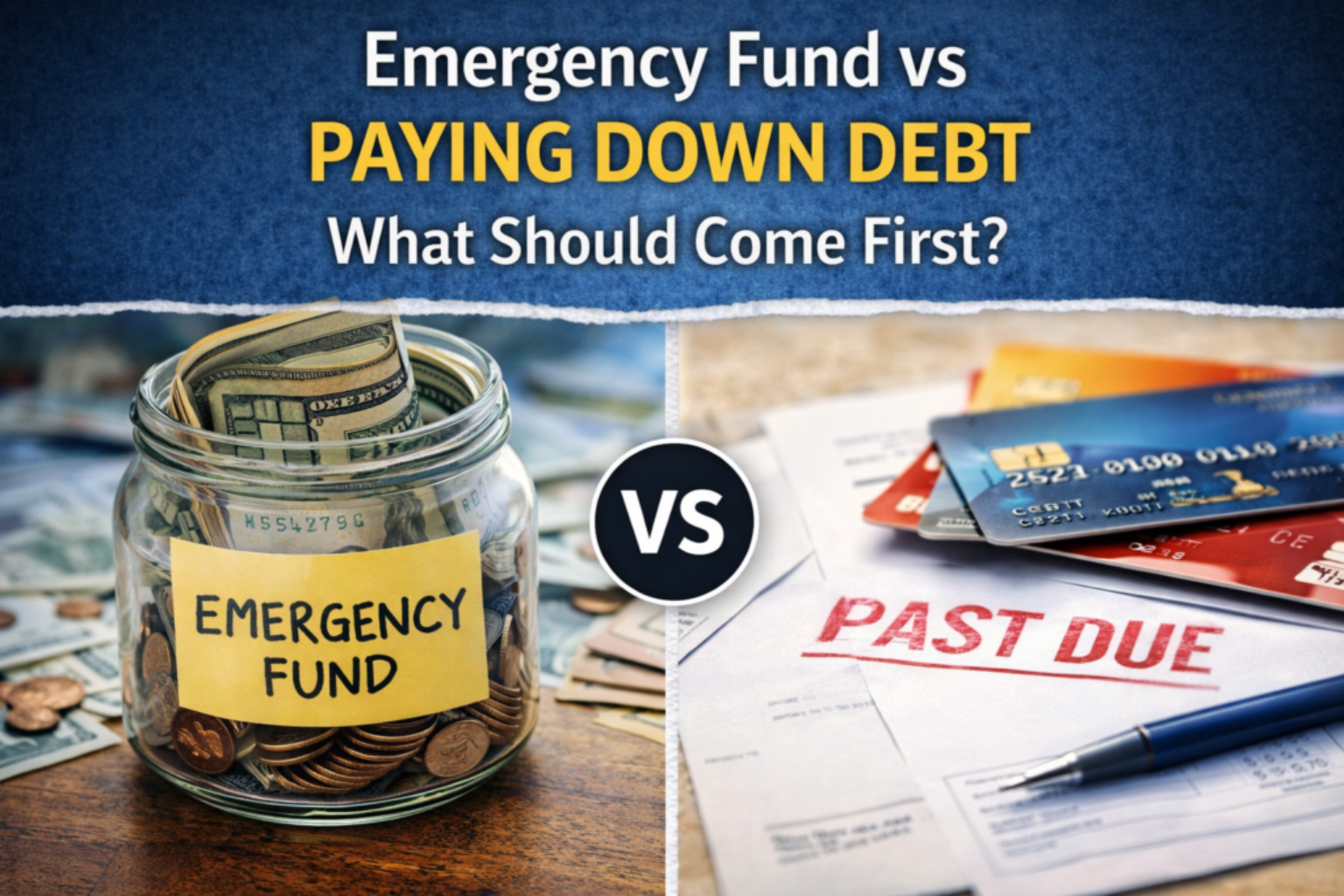
Deciding between an emergency fund vs paying down debt is one of the hardest personal-finance tradeoffs because both goals matter right away. A cash cushion protects you from unexpected expenses, but expensive debt keeps draining your monthly budget. The CFPB says emergency savings helps protect against unplanned costs and income loss, while the Federal Reserve reported that in 2024 only 55% of U.S. adults said they had savings set aside for three months of expenses.
That is why this is not really an “either everything to savings” or “everything to debt” question. In practice, most households need some level of both. CFPB research on a savings-versus-debt scenario found that people generally wanted to keep a savings cushion while also using at least some money to reduce debt, which suggests the real answer is often a balancing act rather than an extreme.
Why this decision matters
Without emergency savings, even a modest financial shock can push you back into borrowing. The CFPB says that without savings, a financial shock can have a lasting impact, and people may end up relying on credit cards or loans that are harder to pay off. At the same time, debt can keep your budget so tight that saving feels impossible.
This tradeoff matters even more if your income is not perfectly stable. CFPB guidance on job loss notes that unemployment benefits rarely replace all your income, which means a household with no cash buffer can still be in trouble even if some benefits arrive.
When an emergency fund should come first
For many people, a starter emergency fund should come first if they currently have little or no cash set aside. The CFPB says even a small amount of emergency savings can provide some financial security, and that putting money aside for unplanned expenses helps you recover faster and get back on track.
Emergency savings should usually come first if:
- you have no real cash buffer
- your income is unstable or you face layoff risk
- you have dependents or high essential bills
- a single surprise expense would force you to borrow immediately
The reason is simple: if you throw every spare dollar at debt while keeping zero cash, the next car repair, medical bill, or income dip often sends you right back to the credit card. That can undo progress fast. CFPB’s emergency-fund guidance specifically frames emergency savings as protection against the kinds of unplanned expenses that otherwise turn into debt.
When paying down debt should come first
Debt should move to the front of the line once you have at least a modest cushion and the debt is especially expensive. The CFPB has highlighted that paying off high-interest debt is a key financial priority, noting that high-interest debt can cost more than what people normally make on investments over time. While that specific CFPB post discusses debt before investing, the core idea still applies here: very expensive debt can damage your financial position quickly.
Paying down debt should take the lead if:
- you already have some emergency savings
- the debt is high-interest revolving debt, especially credit-card debt
- your minimum payments are consuming too much of your monthly cash flow
- the debt is growing faster than you can realistically save
This is especially true when the debt itself is part of the emergency. If a balance keeps snowballing because of interest charges and fees, eliminating that pressure can improve your financial stability just as much as growing savings.
What should most households do?
For most households, the smartest answer is:
Build a small starter emergency fund first, then focus aggressively on high-interest debt while keeping the emergency fund intact.
That middle path fits both current CFPB guidance and CFPB research. The agency’s emergency guide emphasizes that even small savings help, while its savings-versus-debt experiment found that most people wanted to preserve at least part of a savings cushion while still paying down debt.
In practical terms, that usually looks like this:
- build a small starter emergency fund
- keep making at least minimum payments on all debts
- direct extra money toward the highest-interest debt
- once the expensive debt is under better control, grow the emergency fund further
That structure works because it reduces the risk of new borrowing while still attacking the part of your finances that is actively costing you money every month.
How much savings should you have before attacking debt hard?
There is no single official number that fits everyone. The CFPB says the amount you need in emergency savings depends on your situation and that even a small amount can help. So the exact size of a starter fund is a practical judgment, not a federal rule.
A reasonable approach for many households is to build a starter cushion large enough to handle smaller shocks, then switch most extra cash toward high-interest debt. That way, one surprise bill does not immediately push you back into borrowing. The CFPB’s own research supports the idea that consumers are not comfortable going to zero savings even when they have debt, which makes this kind of starter-buffer approach sensible.
When you may want to build more savings before attacking debt
Some households should lean more toward savings before going full speed on debt.
That includes people who:
- work in unstable industries
- are self-employed or freelance
- rely on one income to support a family
- have highly unpredictable expenses
- are at serious risk of an income interruption
In those cases, a larger cash buffer may matter more because the emergency is not just a surprise bill. It might be a month or more of reduced income. CFPB’s job-loss guidance says unemployment generally does not replace all income, which is exactly why households with higher income risk often need more cash resilience before focusing entirely on debt reduction.
When you may want to lean harder into debt payoff
Other households can safely lean more toward debt payoff after building a starter emergency fund.
That usually includes people who:
- have stable jobs
- live in dual-income households
- have manageable fixed expenses
- already have some savings
- are carrying costly credit-card balances
In those cases, once you have a basic cushion, the highest-value move is often to reduce expensive debt faster. The CFPB’s high-interest-debt guidance supports the idea that costly debt can seriously drag down financial progress.
A simple rule for choosing what comes first
Use this rule:
- No savings at all? Build a starter emergency fund first.
- Starter fund already in place and debt is expensive? Shift extra cash toward debt.
- Income is shaky or one paycheck supports the household? Keep more savings before going all-in on debt.
- Income is stable and debt is draining you monthly? Lean harder into debt payoff after the starter cushion is set.
That is usually the cleanest answer to the emergency fund vs paying down debt question.
Final answer: emergency fund or debt first?
For most people, the best order is not “debt only” or “savings only.” It is:
start with a small emergency fund, then attack high-interest debt, then build your emergency fund bigger over time.
That answer matches the logic in CFPB guidance: emergency savings protects you from new borrowing, and high-interest debt needs attention because it keeps costing you money. CFPB research also shows people naturally try to do both, preserving some savings while still paying down debt.
If your income is very unstable, savings should get more weight. If your income is steady and your debt is very expensive, debt can take more priority once you have that starter cushion. The right answer is the one that makes your household less fragile next month, not just better on paper.
FAQ
Should I build an emergency fund before paying off credit-card debt?
Usually, build a small starter emergency fund first, then focus hard on high-interest credit-card debt. That helps prevent new borrowing when a surprise expense hits.
How much emergency savings should I have before paying down debt?
There is no single official number. The CFPB says the amount depends on your situation and that even a small amount can provide security.
What if I have no savings and a lot of debt?
Start with a modest cash cushion first. If you have zero savings, even a small emergency can force you to borrow more. Then shift extra cash toward your most expensive debt.
Does job stability change the answer?
Yes. If your income is unstable, savings deserves more priority because unemployment and income disruptions may leave gaps that debt payoff alone cannot solve. CFPB says unemployment rarely replaces all income.
Is it ever okay to focus almost entirely on debt?
Yes, once you already have some emergency savings and your debt is high-interest and costly. In that case, faster payoff can improve cash flow and reduce financial strain.