
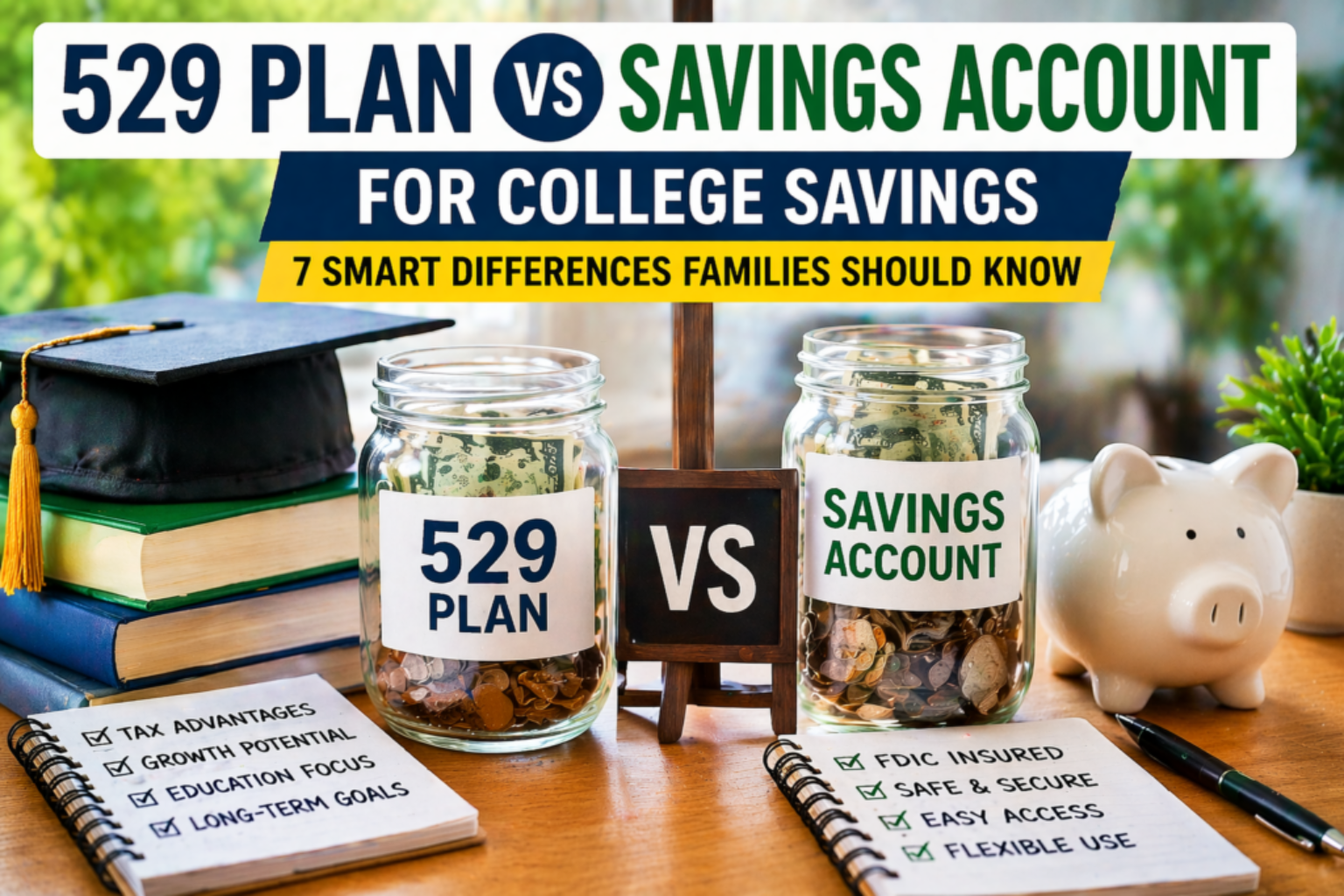
529 Plan vs Savings Account for College Savings: 7 Smart Differences Families Should Know
529 plan vs savings account for college savings is really a question about purpose. A 529 plan is built specifically for education and comes with tax advantages, while a savings account is built for safety, simplicity, and access. Investor.gov says a 529 plan is a tax-advantaged savings plan designed to encourage saving for future education costs, while the FDIC says a savings account is a deposit account insured at an FDIC-insured bank up to the applicable limits.
That means the right choice depends on what your family wants most. If the main goal is long-term education saving and you want the extra tax benefits tied to that purpose, a 529 plan is often stronger. If you want maximum flexibility, less complexity, and easy access in case the goal changes, a savings account can make more sense. The strongest choice is not always the one with the biggest upside. It is the one that best fits your time horizon, risk tolerance, and how certain you are that the money will be used for education.
Table of Contents
What a 529 plan is
Investor.gov says a 529 plan is a tax-advantaged savings plan designed to encourage saving for future education costs. It also says there are two types of 529 plans: education savings plans and prepaid tuition plans. Most families who compare a 529 plan vs savings account for college savings are really deciding between an education savings plan and a normal bank savings account.
When evaluating a 529 plan vs savings account for college savings, it is crucial for families to consider the significant differences in tax advantages, growth potential, and usage restrictions associated with each option. A 529 plan not only provides tax-free growth and withdrawals for qualified education expenses but may also offer state-specific tax incentives. In contrast, a standard savings account typically lacks these benefits and may yield lower interest returns over time. Ultimately, the choice hinges on a family’s financial goals and commitment to funding higher education.
That is what makes a 529 plan attractive. It is not just a place to hold cash. It is a college-focused savings structure with special rules designed to reward families for saving for education.
What a savings account is
A savings account is much simpler. The FDIC says deposit insurance protects money you hold at FDIC-insured banks in traditional deposit accounts like savings accounts, and the standard maximum deposit insurance amount is $250,000 per depositor, per insured bank, per ownership category.
That means when families compare 529 plan vs savings account for college savings, the savings account side of the decision is mostly about:
- principal protection
- easy access
- low complexity
- flexibility if plans change
You are not getting the same education-specific tax structure as a 529 plan, but you are getting safety and simplicity.
Tax benefits: where a 529 plan wins
This is the clearest advantage for the 529 plan.
The SEC’s 2026 bulletin says that if 529 withdrawals are used for qualified higher education expenses and certain other allowed education-related uses, earnings in the account are not subject to federal income tax and, in many cases, state income tax. It also says nonqualified withdrawals generally face state and federal income taxes plus an additional 10% federal tax penalty on earnings.
That makes the 529 plan very appealing for families who are reasonably sure the money will be used for education. The longer the money stays invested for qualified education use, the more valuable that tax treatment can become. The SEC bulletin specifically says one benefit of 529 plans is tax-free earnings growth over time, and it notes that you lose some of those potential benefits if you withdraw money soon after contributing it.
A regular savings account does not give you that same tax structure. It is safer and simpler, but it is not an education tax shelter.
Safety and access: where a savings account wins
A savings account usually wins on safety and easy access.
The FDIC says savings accounts at FDIC-insured banks are covered by deposit insurance, generally up to $250,000 per depositor, per insured bank, per ownership category. That means the money is protected against bank failure within those limits.
A 529 plan does not work like that because, in most cases, the money in an education savings plan is invested in market-based options chosen from the plan’s menu. The SEC bulletin says education savings plans have preset investment options and that account holders cannot switch freely among them; under current tax law, they are generally permitted to change investment options only twice per year or when the beneficiary changes.
So if your family’s top priority is principal stability and quick access, a savings account often feels easier and safer.
Investment risk vs principal protection
This is one of the most practical parts of the 529 plan vs savings account for college savings decision.
A 529 education savings plan usually involves investment risk because the money is invested for growth. A savings account protects principal within FDIC limits, but growth is usually much more modest. The SEC bulletin emphasizes that 529 plans involve preset investment choices and restrictions, while the FDIC’s deposit-insurance materials emphasize protection of deposits in savings accounts.
That means:
- a 529 plan may offer stronger long-term growth potential
- a savings account offers stronger short-term principal certainty
This is why time horizon matters so much. The longer the runway, the more the 529’s tax-advantaged growth can help. The shorter the runway, the more valuable the savings account’s stability becomes.
Flexibility if plans change
Families often worry about what happens if the child does not use all the money for college or if education plans change.
The SEC’s 2026 bulletin says that nonqualified 529 withdrawals generally trigger taxes and a 10% federal tax penalty on earnings. But it also notes one important flexibility point: under current rules, funds can be rolled over from a 529 account into a Roth IRA for the same beneficiary, subject to restrictions. The bulletin says the total rollover amount is limited to $35,000, annual Roth IRA contribution limits still apply, the 529 must have been open for at least 15 years, and the funds rolled over must have been in the 529 for at least five years.
That is a real flexibility upgrade compared with older perceptions of 529 plans, but it is still not the same as having money in a plain savings account. A savings account gives you much more open-ended use. If the family decides the money is needed for something other than education, the account does not impose an education-use rule or penalty structure. The tradeoff is that you also lose the education-specific tax advantages.
Which option is better for short-term goals
If college is only a few years away and your family mainly wants to protect the money from market swings, a savings account often deserves serious consideration.
That is because the FDIC-insured savings account offers stability, easier access, and less complexity. A 529 plan can still work in shorter time frames, but the SEC bulletin makes clear that it is an investment-based structure with restrictions on changing options and with the biggest benefits showing up when money stays invested and is later used for qualified education expenses.
So for short-term college goals, the question is often not “Which has the biggest upside?” It is “How much risk can we tolerate with money we may need soon?”
Which option is better for long-term college savings
For longer timelines, the answer often shifts.
When a family has many years before the money is needed and is reasonably confident the savings are truly for education, a 529 plan often becomes more attractive. Investor.gov describes 529 plans as tax-advantaged education savings plans, and the SEC bulletin explains that the tax-free treatment of qualified withdrawals and tax-free growth on earnings are core benefits. Over longer periods, those benefits may matter much more than the simplicity of a bank savings account.
That does not make a 529 plan automatically better for every family. But for long-range education saving, its purpose-built tax advantages are hard to ignore.
Can families use both?
Yes, and for many households that may actually be the best answer.
A family might use:
- a 529 plan for long-term college savings
- a savings account for near-term school costs, flexibility, or a buffer in case the plan changes
This two-bucket approach is often practical because it separates longer-range education growth from shorter-range certainty. The sources here do not prescribe that exact strategy, but it is a reasonable planning inference from the different strengths of 529 plans and insured savings accounts.
Final answer
For 529 plan vs savings account for college savings, the simplest rule is this:
Choose a 529 plan when:
- the goal is clearly education
- the timeline is longer
- you want education-specific tax advantages
- you are comfortable with an investment-based structure
Choose a savings account when:
- flexibility matters more
- the timeline is shorter
- principal protection is your top priority
- you want simple access and fewer rules
For many families, the best solution may be to use both: a 529 plan for long-term college funding and a savings account for shorter-term or more flexible education-related savings. Investor.gov and the SEC make clear that 529 plans are purpose-built for education and come with meaningful tax benefits, while FDIC guidance makes clear that savings accounts offer insured safety and simplicity.
FAQ
Is a 529 plan better than a savings account for college?
Often yes for long-term education saving, because Investor.gov and the SEC say 529 plans are tax-advantaged and qualified withdrawals can be federally tax free. But a savings account may be better when flexibility and principal protection matter more.
Are savings accounts safer than 529 plans?
In one important sense, yes. FDIC-insured savings accounts are protected up to the applicable limits, while 529 education savings plans are typically investment-based and can involve market risk.
What happens if I do not use 529 money for education?
The SEC says nonqualified withdrawals are generally subject to federal and state income taxes plus a 10% federal tax penalty on earnings, though there are limited exceptions and rollover options.
Can leftover 529 money be moved somewhere else?
Possibly. The SEC says some 529 funds can be rolled into a Roth IRA for the same beneficiary, but only under specific restrictions including a $35,000 lifetime rollover cap and timing rules.
When should I choose a savings account instead of a 529 plan?
A savings account is often stronger when the education timeline is short, the goal may change, or the family wants maximum simplicity and principal protection. That is a practical inference from FDIC deposit-insurance guidance and the SEC’s explanation of 529 plan structure and restrictions.