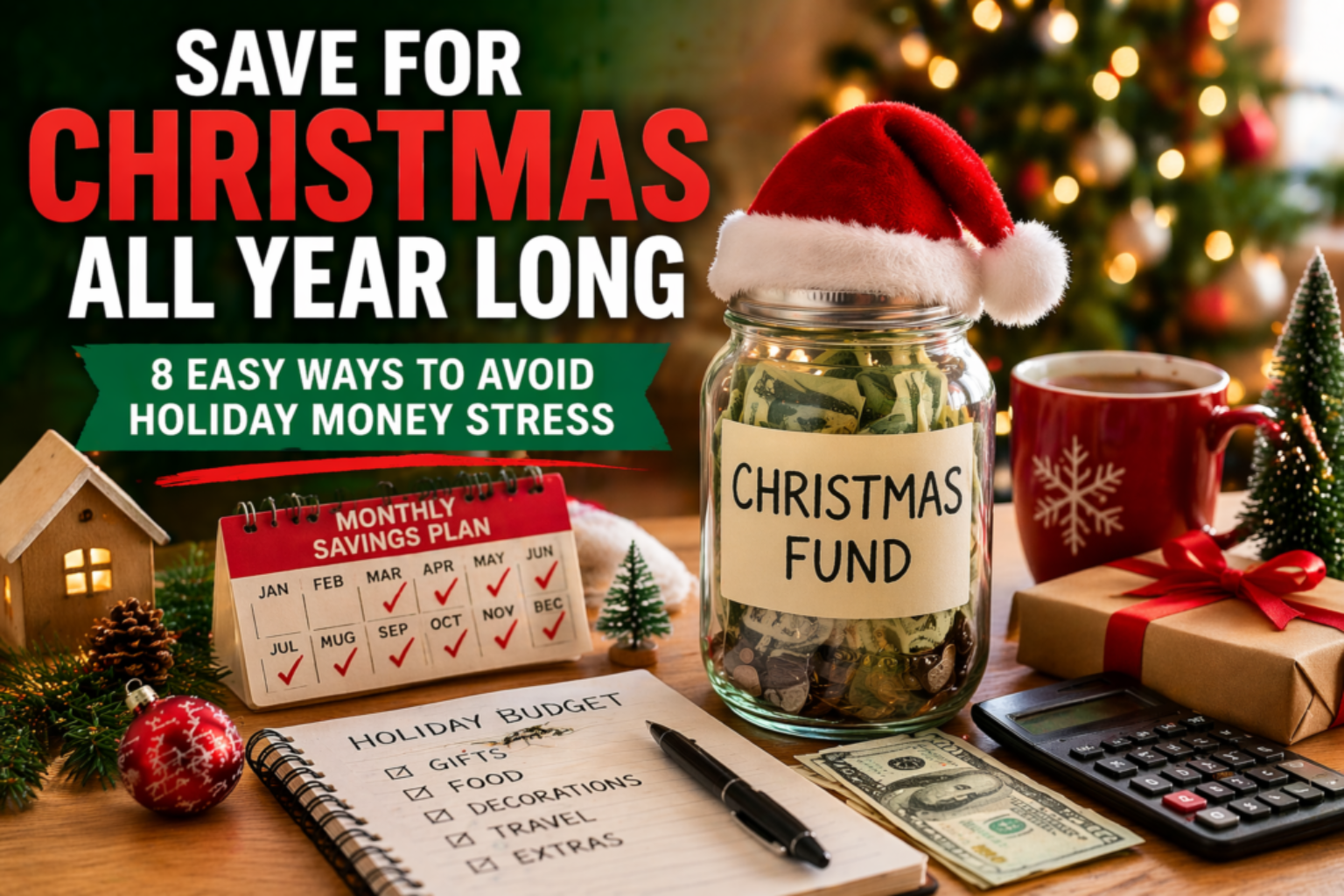
Save for Christmas All Year Long: 8 Easy Ways to Avoid Holiday Money Stress
Save for Christmas all year long by treating holiday spending like a predictable annual bill instead of a December emergency. The CFPB says households should look back over several months of real spending and should not leave out less-frequent costs like gifts, seasonal expenses, and vacations when building a realistic budget. That is exactly why Christmas feels overwhelming for so many families: the expense is expected, but it is often missing from the monthly money plan.
Holiday spending is also not small. The National Retail Federation reported that consumers planned to spend about $890 per person on average in 2025 on gifts, food, decorations, and other seasonal items, and it said this was the second-highest figure in the survey’s history. NRF also notes that many shoppers start early because they want to spread out their budget and avoid last-minute stress.
That is the real solution: stop thinking of Christmas as one giant bill due in late fall. Instead, build a simple year-round system that turns the holidays into manageable monthly savings.
Table of Contents
Why Christmas causes so much money stress
Christmas spending usually becomes stressful for one of three reasons:
- families underestimate the real total
- they wait too long to start saving
- they mix holiday spending with normal monthly bills
The CFPB’s budgeting guidance helps explain the pattern. It says people should look at actual checking and credit card history over the last several months because many households miss less-frequent costs when they estimate spending from memory. Gifts and seasonal expenses are exactly the kind of costs that disappear from the monthly budget until the calendar gets close.
That means the problem is often not Christmas itself. The problem is that the spending shows up as a lump sum inside a budget that was never designed to carry it.
Start with last year’s real holiday spending
The easiest way to save for Christmas all year long is to stop guessing.
Open your bank or credit card history and check what you actually spent last year on:
- gifts
- food and hosting
- travel
- decorations
- shipping
- holiday activities
- gift cards
- charity or church giving
This step matches the CFPB’s advice to review real transaction history when assessing spending. A Christmas budget based on memory is usually too low. A Christmas budget based on actual charges is much more useful.
If you do not have a clean total from last year, that is fine. Build your best estimate now and improve it next year. The important thing is to create a realistic number, not a perfect one.
Build a dedicated Christmas fund
Once you know roughly what the season costs, create a dedicated Christmas savings bucket.
That can be:
- a savings account labeled for holidays
- a subaccount at your bank
- one family sinking-fund account with Christmas tracked separately
The CFPB says one of the easiest ways to save is to make a plan and then set money aside regularly. It also points to automatic transfers or split direct deposit as practical ways to build savings.
A separate Christmas fund matters because money mixed into everyday checking tends to disappear into groceries, gas, and random monthly spending. When holiday money has its own place, it is easier to protect.
Turn Christmas into a monthly savings target
This is the simplest rule in the whole article:
Estimated Christmas total ÷ 12 months = monthly savings amount
If your holiday season usually costs $1,200, save $100 per month.
If it costs $2,400, save $200 per month.
That turns one painful year-end shopping rush into a normal monthly savings habit.
This approach fits the CFPB’s broader advice on saving for emergencies and the future: make a plan, set aside money regularly, and use systems that reduce the need to make a fresh decision every month.
It also makes the season feel calmer. You are no longer “finding” Christmas money in November. You are building it all year.
Break your holiday budget into categories
A single Christmas number is helpful, but category budgeting works better because it gives each dollar a job.
Try categories like:
- immediate family gifts
- extended family gifts
- food and hosting
- travel
- decorations
- gift cards
- giving
- seasonal events
This matches the way NRF describes winter holiday spending as a mix of gifts, food, decorations, and other seasonal items, rather than one undifferentiated total.
Category planning helps because it answers practical questions early:
- How much are we spending on gifts?
- How much is for hosting?
- Are we budgeting for travel separately?
- Are decorations part of the plan or impulse spending?
Once the categories are visible, it is much easier to protect the parts that matter and trim the parts that do not.
Start shopping earlier, not harder
One of the smartest ways to save for Christmas all year long is to spread out some of the purchases too, not just the savings.
NRF says a large share of holiday shoppers start browsing and buying before November, and one of the reasons shoppers start early is to spread out their budget and avoid stress. Its 2025 winter-holiday material also said 42% of holiday shoppers planned to browse and buy items before November.
Starting early helps because it lets you:
- buy across more paychecks
- avoid last-minute premium prices
- catch items as they go on sale
- reduce shipping rush costs
- notice when you are overspending before it is too late
The goal is not to turn Christmas into a 12-month shopping project. The goal is to remove the financial pressure that comes from trying to buy everything in a few weeks.
Keep Christmas separate from your emergency fund
This part matters.
Christmas is important, but it is not an emergency. The CFPB says emergency savings is for unplanned expenses or financial emergencies such as repairs, medical bills, or income loss. That is why holiday spending should not come out of your emergency fund unless you are in a true financial crisis and making a temporary survival decision.
Keeping the categories separate protects both:
- your Christmas fund handles seasonal spending
- your emergency fund stays available for true shocks
This is one of the biggest differences between a stressed household system and a stable one. If every known holiday bill raids emergency savings, the emergency fund never gets to do its real job.
Use automatic savings to stay consistent
The CFPB says automatic saving is one of the easiest and most consistent ways to grow savings. It recommends setting up an automatic transfer from checking to savings or using split direct deposit if your employer allows it.
Christmas is one of the best uses for automation because:
- the date is fixed
- the need is predictable
- the monthly target is easy to calculate
A simple setup looks like this:
- payday arrives
- one or two days later, money moves to the Christmas fund
- repeat every paycheck or every month
This removes the need to “be disciplined” over and over. You decide once, and the system keeps working.
Use windfalls and extra-income moments wisely
If you get extra money during the year, using part of it for the holiday fund can reduce year-end stress even more.
Good examples:
- tax refund
- bonus
- side-income month
- cashback or rewards money
- third paycheck month in a biweekly pay schedule
The CFPB’s savings guidance encourages making a plan and using opportunities to build savings over time. A windfall does not have to go entirely to Christmas, but directing part of it there can make your monthly target much easier to manage.
What if you are starting late?
Sometimes people do not start in January. That is fine. A late start is still better than no plan.
If you are only a few months out, use this approach:
- estimate a realistic total
- separate must-haves from nice-to-haves
- divide the total by the remaining months or paychecks
- trim lower-priority monthly spending temporarily
- start next year’s Christmas fund immediately after this season ends
NRF says shoppers often start early to spread out their budget and reduce stress. Even if you missed the early window this year, you can still use that lesson to make next year much easier.
Final answer
To save for Christmas all year long, the best system is:
- look at last year’s real holiday spending
- set a realistic total for this year
- divide that number into monthly savings
- keep the money in a dedicated Christmas fund
- break the budget into categories
- automate the savings
- start some shopping earlier
- protect your emergency fund for true emergencies
The CFPB’s budgeting and savings guidance supports the core structure here: use real spending history, include seasonal costs in your planning, and save on purpose instead of waiting until the expense arrives. NRF’s 2025 holiday data shows why that matters so much: consumers still plan to spend heavily during the season, and many intentionally start early to spread out the cost.
When you do that, Christmas stops feeling like a financial ambush and starts feeling like a planned part of the year.
FAQ
How much should I save each month for Christmas?
Take your estimated holiday total and divide it by 12 months. That gives you the cleanest monthly target.
Take your estimated holiday total and divide it by 12 months. That gives you the cleanest monthly target.
Usually no. The CFPB says emergency savings is for unplanned expenses or financial emergencies, while Christmas is a predictable seasonal expense.
How much do consumers spend on Christmas on average?
NRF reported that consumers planned to spend about $890 per person on average in 2025 on gifts, food, decorations, and other seasonal items.
Why do people start Christmas shopping early?
NRF says one major reason people start early is to spread out their budget and avoid the stress of last-minute shopping.
What if I did not start saving early this year?
You can still make a plan now by setting priorities, spreading purchases across remaining paychecks, and starting next year’s Christmas fund right after this season ends.