Where Should You Keep Your Emergency Fund? Best Safe Options Explained
When people ask where should you keep your emergency fund, they are usually trying to balance three things at once: safety, access, and self-control. The CFPB’s emergency-savings guidance says a bank or credit union account is generally one of the safest places to keep your money, and it specifically suggests using a dedicated account for emergency funds. The same CFPB guidance also notes that emergency savings should ideally be kept in an easily accessible account that does not charge taxes, maintenance fees, or early-withdrawal fees.
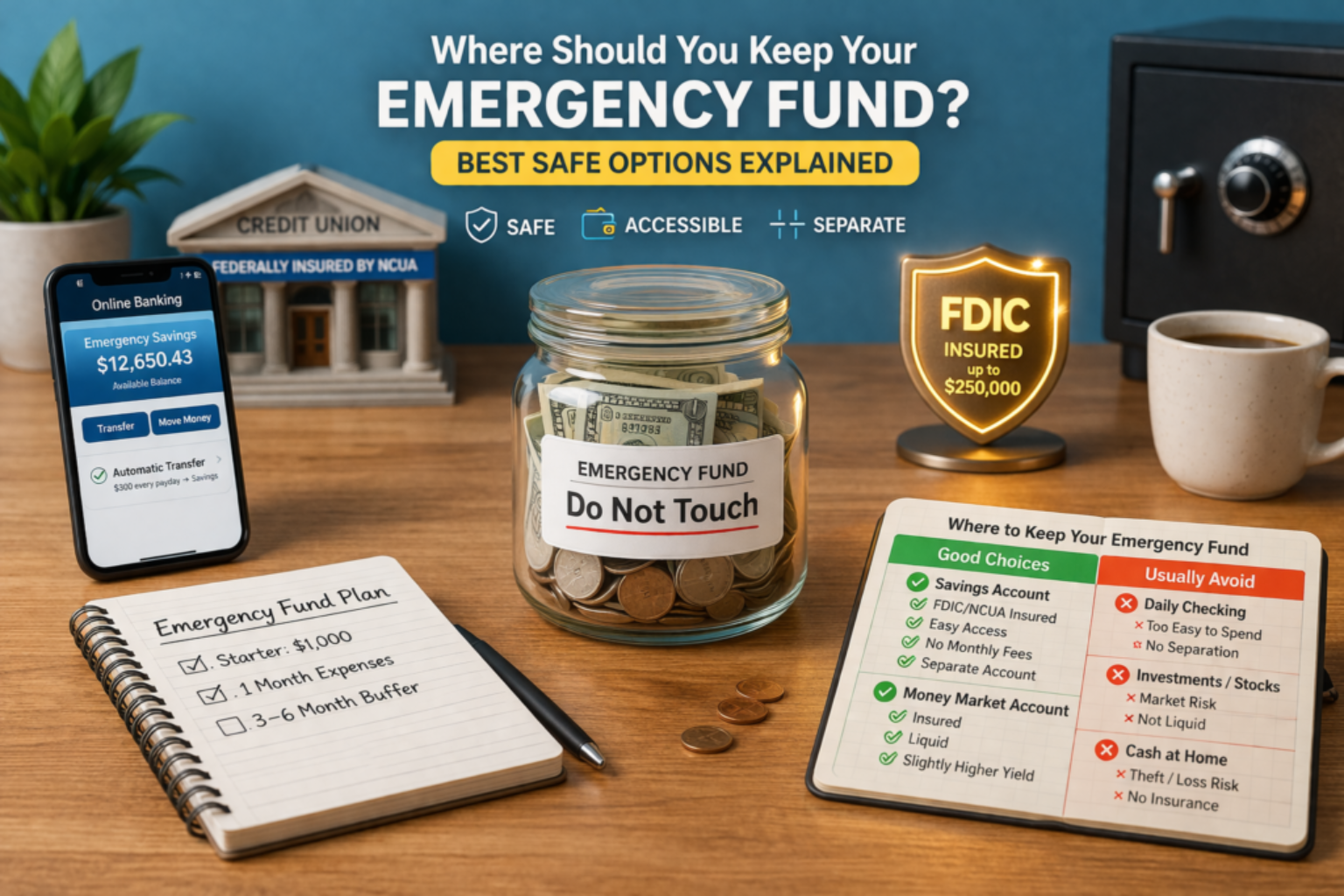
That means the best place for most households is usually a separate savings account at an insured bank or federally insured credit union. Not your daily checking account. Not stocks. Not a long-term investment account. And usually not physical cash sitting around at home. The goal of an emergency fund is not to maximize returns. It is to make sure the money is there when something goes wrong.
The 3 rules for a good emergency fund account
A good emergency fund account should meet three tests:
1. It should be safe
Your emergency money should be protected from bank failure risk by federal insurance when possible. The FDIC says deposits are insured up to $250,000 per depositor, per FDIC-insured bank, per ownership category. The NCUA says individual accounts at federally insured credit unions are also generally insured up to $250,000, with separate rules for joint and certain retirement accounts.
2. It should be easy to access
If your car breaks down or your income drops suddenly, you need the money available without waiting for markets to recover or paying penalties to unlock it. That is why the CFPB points people toward easy-access accounts for emergency savings.
3. It should be separate from everyday spending
Keeping your emergency fund in a separate account makes it easier to protect it from accidental spending. CFPB guidance explicitly suggests a dedicated account for maintaining emergency funds.
Best place for most people: a separate savings account
For most households, the best answer is simple: keep your emergency fund in a separate savings account at an insured bank or federally insured credit union. That setup gives you safety, accessibility, and enough separation from daily spending to reduce temptation. It also works well with automatic transfers, which the CFPB recommends as an easy way to save consistently.
Why this usually works best:
- your money stays relatively liquid
- it is easier to avoid spending it by mistake
- automatic savings transfers are straightforward
- it fits the “safe and accessible” purpose of emergency cash
This is especially true if you are still building your fund and want the simplest system possible.
Should you use checking instead?
Usually, no.
A checking account gives you fast access, but it also makes your emergency fund too easy to spend on regular life. If the money sits next to groceries, subscriptions, online shopping, and monthly bills, it becomes mentally easier to dip into it for non-emergencies.
Checking can make sense for a tiny starter buffer if you are extremely worried about immediate access, but for most people the better setup is:
- checking for regular bills and spending
- savings for emergency cash
- optional separate sinking-fund accounts for planned expenses
That separation is one of the easiest ways to keep emergency money intact. The CFPB’s recommendation for a dedicated account supports that approach.
What about a money market account?
A money market deposit account at a bank or credit union can also be a reasonable place for emergency savings if it is insured and easy to access. From an emergency-fund perspective, the important question is not whether the account sounds more sophisticated. It is whether it keeps your money:
- protected
- available
- separate
- penalty-free for normal emergency use
FDIC deposit insurance applies across covered deposit types at insured banks, including savings, checking, CDs, and money market deposit accounts, subject to the same ownership-category rules. NCUA share insurance also covers various share deposit accounts at federally insured credit unions.
So a money market account can be fine, but it is not automatically better than a normal savings account. For most households, whichever insured option is simpler and easier to maintain is usually the better choice.
Should you keep your emergency fund in a CD?
Usually only a small part of it, if any.
A CD can be appealing because it may offer a predictable return, but it is often a weaker fit for emergency money because the point of emergency savings is quick access. The CFPB says emergency savings should ideally be in an easily accessible account and avoid early-withdrawal fees. A CD may work for a portion of a larger emergency fund if you already have enough liquid cash elsewhere, but it is usually not the best home for your entire fund.
A practical rule:
- keep your core emergency cash in a liquid insured account
- only consider CDs for extra cash if your more immediate emergency layer is already covered
Should you invest your emergency fund?
For most people, no.
Emergency funds and long-term investing serve different jobs. Emergency money is there for stability and access. Investment accounts are built for growth and come with price fluctuations. If the market drops at the same time you lose your job or face a major bill, you may be forced to sell at the wrong moment. That defeats the purpose of having an emergency buffer in the first place.
The safest approach is to keep emergency cash out of assets that can swing in value when you need the money most. CFPB guidance consistently frames emergency savings as money for unexpected expenses and near-term financial security, not as money to take market risk with.
Is cash at home a good idea?
Usually not for the bulk of your emergency fund.
Keeping a small amount of cash at home for short-term disruptions can make sense for some households, but storing a large emergency fund in physical cash creates obvious risks: theft, loss, fire, and zero federal deposit protection. By contrast, funds at FDIC-insured banks and federally insured credit unions receive federal insurance protection up to the applicable limits.
A reasonable compromise is:
- small amount of cash at home if that helps you feel prepared
- the main emergency fund in an insured account
Bank or credit union: which is better?
Either can work well.
The CFPB’s emergency-fund guidance names banks and credit unions as generally safe places to keep your money. The FDIC covers insured bank deposits, and the NCUA covers deposits at federally insured credit unions, both generally up to $250,000 within the applicable rules.
So the better question is not “bank or credit union?” It is:
- Is the institution federally insured?
- Is the account easy to access?
- Are fees low or nonexistent?
- Will this setup help me avoid spending the money casually?
If the answer is yes, either one can be a strong home for an emergency fund.
What features should you look for?
When choosing where to keep your emergency fund, prioritize:
1. Federal insurance
Look for an FDIC-insured bank or a federally insured credit union. Deposit or share insurance is automatic when your institution is covered.
2. No monthly maintenance fee
Emergency savings should not slowly leak away in fees. CFPB guidance specifically points people toward accounts that avoid maintenance and early-withdrawal fees for emergency savings.
3. Easy transfer access
You want to be able to move money when needed without unnecessary friction.
4. Separation from your spending account
A separate account helps protect the fund behaviorally, not just financially. The CFPB’s dedicated-account guidance supports this.
5. Simple automation
The CFPB says automatic transfers are one of the easiest ways to build savings, so choose an account that makes recurring transfers easy to set up.
Best setup for most households
For most readers of CashBuffer Guide, the most practical setup is:
- Primary checking account for income and bills
- Separate emergency savings account at an insured bank or federally insured credit union
- optional separate sinking fund account for planned irregular expenses
This setup keeps your emergency money:
- visible enough to use
- separate enough to protect
- simple enough to maintain
And that is exactly what an emergency fund needs.
Where should you not keep your emergency fund?
Try to avoid keeping your main emergency fund in:
- your daily checking account
- stocks or stock-heavy investment accounts
- retirement accounts
- the bulk of your cash at home
- accounts with penalties or hard-to-reach funds
The reason is the same in every case: your emergency fund should be boring, stable, and available.
Final answer: where should you keep your emergency fund?
For most people, the best place to keep an emergency fund is a separate savings account at an FDIC-insured bank or federally insured credit union. The CFPB says banks and credit unions are generally among the safest places to keep your money, recommends a dedicated account for emergency funds, and says emergency savings should ideally be in an easily accessible account without maintenance or early-withdrawal fees. FDIC and NCUA insurance generally protect covered deposits up to $250,000 within their respective rules.
That is the best mix of safety, accessibility, and discipline for real households.
FAQ
Should an emergency fund be in checking or savings?
Usually savings. A separate savings account helps reduce accidental spending while still keeping the money accessible. The CFPB specifically recommends a dedicated account for emergency funds.
Is a money market account okay for an emergency fund?
Yes, it can be, as long as it is insured, accessible, and fits the same core purpose as a savings account. FDIC and NCUA coverage applies to qualifying deposit accounts within their rules.
Is it okay to keep emergency savings in cash at home?
A small amount may be reasonable for immediate disruptions, but keeping the bulk of your emergency fund in physical cash means you lose federal deposit protection and take on theft or loss risk.
Should I invest my emergency fund?
For most people, no. Emergency savings should stay stable and easily accessible rather than exposed to market swings. The purpose is resilience, not return.
Are online banks okay for emergency funds?
They can be, as long as the institution is properly insured, the account is easy to access, and the setup works for your household’s needs. The core criteria are safety, accessibility, and separation from daily spending.