What Order Should You Save Money In? A Simple Priority Plan for Households
If you have ever felt like every money goal is urgent at the same time, you are not imagining it. You may need emergency savings, want to pay down debt, need to save for retirement, and still have real-life expenses like car repairs, medical bills, and annual insurance costs. The CFPB says emergency savings is one of the first steps you can take to protect yourself from unplanned expenses, and it also says building a budget helps you pay bills on time, get control of debt, and save for the future.
There is no single official government “order of saving” checklist that fits every household. But there is a practical order that works well for many people because it reduces financial fragility first, captures obvious advantages second, and then builds toward bigger long-term goals. What follows is a household priority plan, not a legal or tax requirement. It is based on current CFPB and IRS guidance plus reasonable financial sequencing.
Step 1: Get current on essential bills and stop the bleeding
Before you focus on “saving” in the usual sense, make sure your essential bills are covered and your budget is grounded in reality. The CFPB says creating a budget helps you figure out what you owe monthly, where you actually spend money, and how to prioritize paying bills on time, controlling debt, and saving for the future.
This first step means:
- cover housing, utilities, groceries, transportation, and insurance
- avoid new late fees and overdraft problems
- know what is coming out of your account each month
If your money system is chaotic, every other goal becomes harder to sustain.
Step 2: Build a starter emergency fund
After essentials are stable, your next priority is usually a starter emergency fund. The CFPB says an emergency fund is cash set aside for unplanned expenses or financial emergencies such as car repairs, home repairs, medical bills, or a loss of income. It also says even a small amount can provide some financial security.
This matters because without savings, even a minor shock can push you into new debt. CFPB guidance specifically warns that without savings, a financial shock can have lasting effects and may push people toward credit cards or loans that are harder to pay off.
So the first savings target is not perfection. It is protection.
Step 3: Take the employer retirement match if you have one
If your employer offers a 401(k) or similar plan with a match, this usually moves near the top of the list. The IRS says employers can contribute to employees’ 401(k) accounts, including through matching contributions, and those matching contributions are part of the total plan contribution structure.
Why this step comes early: employer matching money is one of the few places where your savings effort may be directly increased by employer contributions under plan rules. That makes it a strong priority once you have at least a basic cash cushion. This is a practical inference from IRS plan rules, not an IRS-issued savings hierarchy.
A simple rule:
- no emergency cushion at all → build a starter fund first
- starter fund in place and employer match available → contribute enough to capture the match
Step 4: Attack high-interest debt
Once you have a starter emergency fund and have captured any obvious employer match, high-interest debt usually deserves aggressive attention. The CFPB says there are two common debt-paydown strategies, but it also notes that the highest interest rate method targets the debts costing you the most and can save money in the long run.
This is where a lot of households make their biggest financial progress. High-interest debt can drain cash flow every month, making it harder to save for anything else. CFPB guidance for servicemembers makes the same basic point in stronger terms: paying off high-interest debt should come before investing because the interest cost can outweigh what you would normally make elsewhere.
So the order here is not “save nothing and dump everything into debt.” It is:
- keep the starter emergency fund intact
- keep essentials current
- then send extra money toward the highest-interest balances
Step 5: Grow your emergency fund into a real buffer
After the most expensive debt is under better control, the next priority is usually expanding your emergency savings. The CFPB says the amount you need depends on your situation and the most common unexpected expenses you have had in the past. It also emphasizes that emergency savings should be kept for unplanned expenses, not routine monthly spending.
At this stage, you are moving from:
- starter emergency fund
to - a stronger household cash buffer
This is the point where your finances become less fragile. You are not just surviving the next surprise bill. You are building room to absorb bigger disruptions.
Step 6: Use tax-advantaged accounts that fit your situation
Once you have a better cash cushion and high-interest debt is less urgent, tax-advantaged saving usually becomes the next major priority.
HSA first, if you are eligible
The IRS says an HSA lets eligible people deduct contributions, exclude employer contributions from income, grow earnings tax free, and take tax-free distributions for qualified medical expenses.
That makes the HSA one of the strongest savings tools available if you qualify. This is why many households should prioritize it once emergency savings and debt pressure are more under control. That ranking is an inference from IRS rules, not an official IRS priority list.
IRA next, if it fits your tax picture
The IRS says an IRA is a personal savings plan that gives you tax advantages for retirement, and it explains that traditional IRA contributions may be fully or partially deductible while Roth IRA qualified distributions may be tax free.
So if you are asking what order to save money in, tax-advantaged retirement saving usually comes after you have basic stability but before lower-priority lifestyle goals.
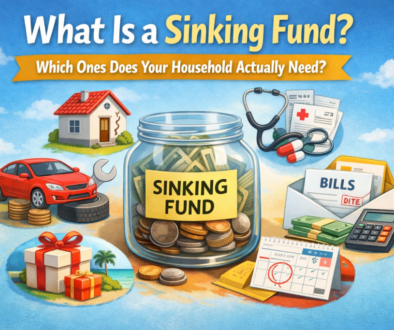
Step 7: Build sinking funds for predictable costs
Once your core emergency savings and retirement direction are in place, start separating true emergencies from predictable expenses. The CFPB says emergency savings is for unplanned expenses, which implies that known but irregular costs should be handled differently.
This is where sinking funds come in:
- car maintenance
- annual insurance bills
- holidays
- school costs
- home repairs you know are likely
These are not random emergencies. They are future bills you can plan for. Organizing them separately protects your emergency fund from getting drained by costs you could see coming.
Step 8: Save for medium- and long-term household goals
Only after the earlier priorities are reasonably in place should most households push hard on goals like:
- vacations
- large home upgrades
- extra investing beyond current priorities
- major lifestyle upgrades
That does not mean these goals are unimportant. It means they usually belong after:
- essential stability
- emergency savings
- employer match
- high-interest debt control
- tax-advantaged saving
The CFPB’s broader budgeting guidance supports this logic: get your obligations under control, know where your money goes, and then direct leftover cash intentionally toward future goals.
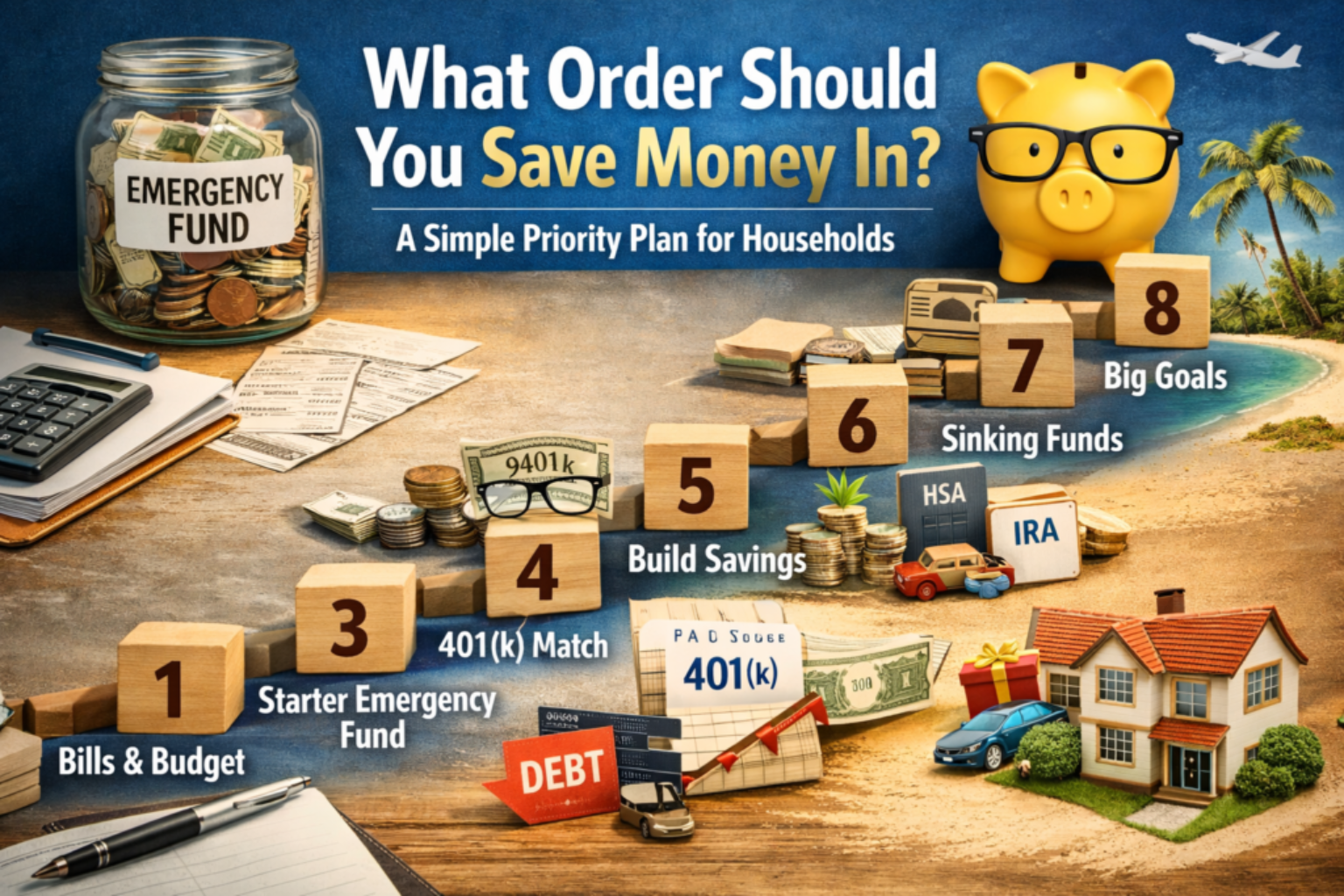
A simple priority order for most households
Here is the clearest version:
- Current bills and cash-flow stability
- Starter emergency fund
- Employer retirement match, if available
- High-interest debt payoff
- Larger emergency fund
- HSA if eligible / IRA or broader retirement saving
- Sinking funds for predictable expenses
- Other family goals and extra investing
This order is not a law. It is a practical framework built from CFPB emergency and debt guidance plus IRS rules on retirement and HSA accounts.
Final answer: what order should you save money in?
For most households, the right order is:
stabilize bills → build a starter emergency fund → capture employer match → pay down high-interest debt → grow emergency savings → prioritize tax-advantaged accounts → fund predictable future expenses → save for other goals.
The reason this order works is simple. It reduces risk first, captures easy financial advantages next, and only then moves into longer-range goals. The CFPB says emergency savings protects you from unplanned costs, and its debt guidance shows why expensive debt deserves focused attention. IRS rules explain why employer retirement plans, HSAs, and IRAs matter once your foundation is stronger.
If your situation is unusual, the order may shift a bit. But for a typical household, this is the simplest sequence that makes your money life more stable over time.
FAQ
What should I save for first?
Usually a starter emergency fund after getting essential bills current. The CFPB says even a small amount of emergency savings can provide financial security.
Should I save or pay off debt first?
For many households, do both in sequence: build a small emergency cushion first, then focus extra money on high-interest debt. CFPB says people generally want to keep a savings cushion while also paying down debt.
Should I prioritize my 401(k) before my emergency fund?
Usually build at least a small emergency fund first. After that, if your employer offers a match, contributing enough to capture it is often a strong next move. IRS says employers can make matching contributions to 401(k) accounts.
Is an HSA better than an IRA?
If you are eligible, the HSA often comes first because IRS rules allow deductible or excluded contributions, tax-free growth, and tax-free qualified medical withdrawals.
When should sinking funds come in?
Usually after you have a stronger base. Sinking funds are best for predictable costs so that your emergency fund stays reserved for true surprises.