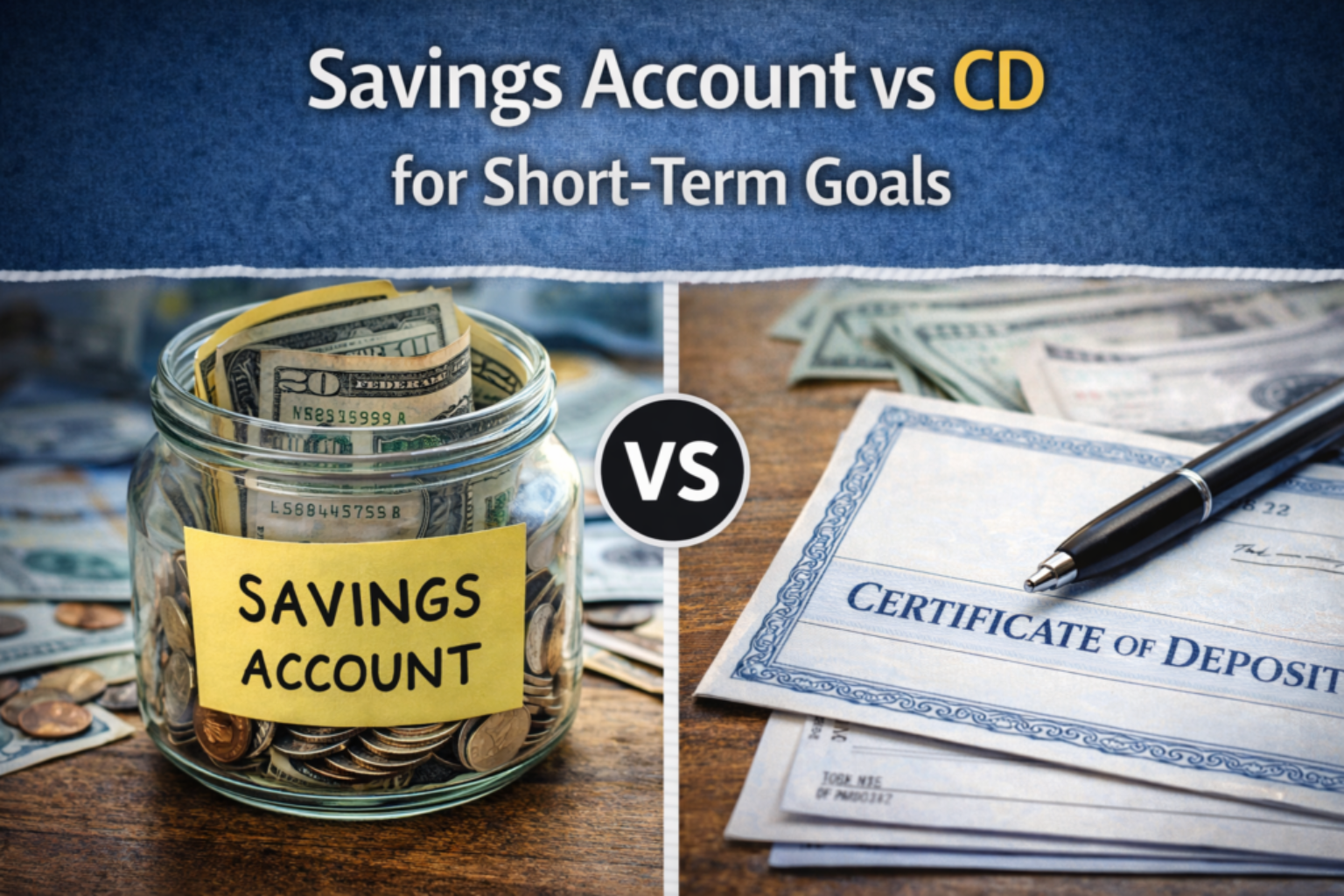
Savings Account vs CD for Short-Term Goals
If you are deciding between a savings account vs CD for short-term goals, the real question is not which one sounds more “serious.” It is which one matches your timeline, your need for access, and your tolerance for locking money up. The FDIC says both savings accounts and certificates of deposit (CDs) are deposit products, and FDIC insurance covers both when they are held at an FDIC-insured bank. The CFPB also says a CD is a type of savings account where you generally agree to keep your money deposited for a specified term, and taking money out early usually means paying a penalty.
For most people, a savings account is better when the goal is flexible or the timing is uncertain. A CD can be better when you know you will not need the money before a specific date and want the structure of a fixed term. The wrong choice is usually the one that forces you to pay a penalty or lose flexibility because your timeline changed.
What a savings account is best for
The FDIC says a savings account is used to set aside money for the future and is generally meant for money you do not expect to use on a regular basis. The CFPB also says savings accounts are best used for emergencies and infrequent purchases rather than day-to-day transactions.
That makes savings accounts a strong fit for short-term goals like:
- emergency funds
- car repairs you are preparing for
- vacation money if the date is not fixed
- moving expenses
- annual bills you may need to pay earlier than expected
The advantage is flexibility. You can move money in and out as needed, subject to the bank or credit union’s account rules and possible excess-withdrawal fees. The CFPB says institutions may charge fees for too many withdrawals or transfers from a savings account, which is one reason checking is better for daily transactions and savings is better for money you access only occasionally.
What a CD is best for
The CFPB says a CD is a type of savings account where you agree to leave money on deposit for a set term, and withdrawing money early means paying a penalty to the bank. The FDIC similarly says that unlike a regular savings account, you generally cannot withdraw from a CD whenever you want; you typically must keep the money there for the agreed period or pay a penalty or lose some or all of the interest.
That makes CDs a better fit for short-term goals like:
- a known wedding expense next year
- a tax payment you know is coming
- tuition due on a specific date
- a home project with a planned start date
- cash you know you will not need before the CD matures
The key phrase is know you will not need. A CD works best when the goal has a clear date and the money can stay untouched until then.
Safety: both are protected deposit products
On basic safety, there is no major difference if both accounts are at a properly insured institution. The FDIC says deposit insurance covers savings accounts and CDs at FDIC-insured banks, generally up to $250,000 per depositor, per insured bank, per ownership category. The NCUA says federally insured credit unions provide up to $250,000 of share insurance as well.
So if your question is “which is safer from bank-failure risk,” the answer is that both can be appropriate protected places for short-term cash when they are properly insured.
Access: savings accounts win
This is where the biggest practical difference shows up.
A savings account gives you more flexibility because the money is not tied to a maturity date. A CD does not. The CFPB says you generally agree to keep money in a CD for a specified length of time, and early withdrawal means a penalty fee. The FDIC also notes that a CD is designed for a term that can range from a few months to five years or more.
That means:
- if your goal date might move, savings is usually better
- if your goal is uncertain, savings is usually better
- if you might need the money early, savings is usually better
For short-term goals with any uncertainty, access usually matters more than squeezing out a slightly different account structure.
Penalties: CDs require more caution
The biggest risk of using a CD for short-term goals is not safety. It is mismatch.
The CFPB says early withdrawal from a CD means paying a penalty fee. FDIC guidance for CD shoppers also says the terms of most fixed-rate CDs allow early redemption only if you pay a fee, and that people should compare the penalty carefully before opening one. In addition, FDIC Truth in Savings guidance says institutions must disclose whether an early-withdrawal penalty will apply and how it is calculated.
So before using a CD for a short-term goal, you need to know:
- the maturity date
- the penalty for early withdrawal
- whether the goal date is truly fixed
- whether you could need that cash sooner than expected
If you are not confident about those answers, a savings account is usually the safer choice in practical terms.
Which is better for 3 to 6 month goals?
For very short-term goals, especially inside a 3 to 6 month window, a savings account is usually the better fit unless you are certain you will not touch the money early.
Why:
- the timeline is short
- unexpected needs are more likely to overlap with the goal
- the penalty risk on a CD matters more when the time horizon is short
- flexibility is often more valuable than locking in a term
This is especially true for emergency funds. The CFPB’s savings-account guidance explicitly says savings accounts are suited to emergencies and infrequent purchases, which strongly favors savings over CDs for money that might need to move without warning.
Which is better for 6 to 24 month goals?
For goals in the 6 to 24 month range, the answer depends more on certainty.
A CD can make sense if:
- you know the date you will need the money
- you will not need the money before then
- you have other liquid cash for emergencies
- you have reviewed the penalty and still feel comfortable
A savings account is better if:
- the date is flexible
- the amount may change
- you are still building an emergency fund
- you do not want any chance of paying an early-withdrawal penalty
Emergency fund vs short-term goal fund
This distinction matters.
A short-term goal fund is money you plan to use.
An emergency fund is money you hope not to use unless something goes wrong.
Because of that, the emergency fund usually belongs in a savings account, not a CD. The CFPB says savings accounts are suitable for emergencies and infrequent purchases, while CDs are term-based accounts that charge penalties for early withdrawals. That makes savings the stronger choice for money that needs to stay liquid.
A CD becomes more reasonable for short-term goals only after your emergency cash is already in place somewhere flexible.
What about rollover risk?
The CFPB says banks and credit unions may automatically renew or roll over a CD at maturity unless you tell them not to, and they must send a written notice before maturity explaining when the current CD ends and whether it will renew. The CFPB also says the new rate is not guaranteed to be the same as the old one.
That matters because CDs require more monitoring than savings accounts. If you use a CD for a short-term goal, you need to pay attention to the maturity date and renewal notice so the money does not roll into a new term you did not want.
Best choice for most households
For most households, the best rule is simple:
Use a savings account for short-term goals unless the date is fixed and you are sure you will not need the money early.
That recommendation fits the official guidance well:
- the FDIC says savings accounts are used for future needs and CDs tie money up for a term with penalties for early access
- the CFPB says savings accounts are appropriate for emergencies and infrequent purchases, and CDs come with early-withdrawal penalties
So the default option is:
- Savings account for flexibility
- CD for certainty
Final answer: savings account or CD for short-term goals?
A savings account is usually better for short-term goals when your timeline is flexible, your goal amount may change, or you might need the money early. A CD is better when the date is fixed, the money can stay untouched until maturity, and you are comfortable with the possibility of an early-withdrawal penalty if plans change. Both are insured deposit products when held at an insured bank or federally insured credit union.
For most readers, the simplest answer is:
Savings account first. CD only when certainty is high.
FAQ
Is a savings account or CD better for short-term goals?
Usually a savings account is better if you need flexibility. A CD can be better when you know you will not need the money before a specific maturity date.
Are CDs safe?
Yes, CDs at FDIC-insured banks are insured deposit products, generally up to $250,000 per depositor, per insured bank, per ownership category. Federally insured credit unions offer similar protection through the NCUA.
Can I take money out of a CD early?
Usually yes, but the CFPB says early withdrawal generally means paying a penalty fee to the bank or credit union.
Should I use a CD for my emergency fund?
For most people, no. Emergency funds usually belong in savings because the money may need to be accessed without warning, and CDs are built around fixed terms and early-withdrawal penalties.
What happens when a CD matures?
The CFPB says a CD may automatically roll over or renew unless you instruct the institution otherwise, and the bank or credit union must send a notice before maturity.