
How to Save Your First $1000 Fast Without Wrecking Your Budget
Saving your first $1,000 can feel impossible when rent is high, groceries cost more than they used to, and every paycheck already has a job. But this is one of the most important money goals you can hit. The Consumer Financial Protection Bureau says even a small amount of emergency savings can improve financial security, and the Federal Reserve found that in 2024, only 63% of U.S. adults said they could cover a hypothetical $400 emergency expense using cash or its equivalent. That is exactly why building a first cash buffer matters.
Your first $1,000 is not meant to solve every financial problem. It is meant to stop small emergencies from turning into credit-card debt, overdrafts, or panic. A car repair, urgent prescription, last-minute travel need, or appliance issue may not require a fully funded emergency account, but they can still wreck a tight month. CFPB guidance says emergency savings is meant for unexpected expenses like car repairs, medical bills, or a loss of income, and that is why a starter fund is so valuable.
Why the first $1,000 matters
People often get stuck because they focus on the long-term goal first. Three months of expenses sounds smart, but it can also feel so big that it becomes mentally unreachable. A first $1,000 is different. It is concrete, achievable, and useful right away. The CFPB says even a small amount set aside can provide some financial security, which makes a starter emergency fund a practical first milestone rather than a “small” one.
It also gives you momentum. The Federal Reserve’s 2025 household well-being report found that adults who regularly spent less than their income were far more likely to have emergency savings. Building the first $1,000 is often the point where saving stops being an abstract idea and becomes a repeatable habit.
Step 1: Give the $1,000 a clear purpose
Do not call it “extra money.” Call it your starter emergency fund.
That shift matters because money with a vague purpose gets spent on whatever feels urgent in the moment. Money with a defined job is easier to protect. The CFPB recommends using a dedicated account for emergency savings, which supports the idea that naming and separating the money helps keep it intact.
Your rule can be simple:
This $1,000 is only for true emergencies, not planned spending.
That means it is not for:
- holidays
- shopping
- birthdays you saw coming
- routine car maintenance
- subscriptions
- “treat yourself” spending
It is for:
- urgent repairs
- unexpected medical costs
- sudden travel needs
- temporary income disruption
- other real financial shocks
Step 2: Open a separate savings account
The fastest way to save your first $1,000 is to make it harder to accidentally spend it. For most households, the best place for a starter emergency fund is a separate savings account at an insured bank or federally insured credit union. The CFPB says emergency savings should ideally be kept in an easily accessible account and recommends a dedicated account for emergency funds.
Do not keep this money in your everyday checking account unless you have no other option. When emergency money sits next to groceries, gas, and one-click shopping, it gets mentally downgraded from “protection” to “available cash.”
Step 3: Set a deadline that feels urgent, not punishing
To save your first $1,000 fast, you need a clear timeline. For most people, the best target is somewhere between 30 and 90 days.
A 30-day plan means saving about:
- $250 a week
- or roughly $34 a day
A 60-day plan means saving about:
- $125 a week
- or roughly $17 a day
A 90-day plan means saving about:
- $84 a week
- or roughly $12 a day
You do not need to hit these numbers perfectly every week. The point is to turn a vague goal into a visible target.
Step 4: Start with the easiest money first
Do not begin by trying to become a different person. Start by finding money that is already leaking out of your budget.
The fastest sources are usually:
- unused subscriptions
- dining out you will not really miss
- impulse online spending
- premium phone or streaming plans
- convenience purchases
- extra grocery waste
This approach matters because the Federal Reserve reported that many households are still under pressure from higher prices, and food and groceries remained a top financial concern in 2024. That means trying to save through willpower alone is harder than simply removing waste first.
A good first move is a 48-hour money audit:
- review subscriptions
- scan the last 30 days of transactions
- circle anything you would not buy again today
- redirect that amount to savings immediately
Step 5: Save from each paycheck before you “see” it
The CFPB recommends automatic transfers as one of the easiest ways to build savings. This is one of the most effective ways to reach your first $1,000 quickly without constantly negotiating with yourself.
A simple setup:
- choose a fixed amount from every paycheck
- move it automatically to your emergency savings
- schedule the transfer for payday or the morning after
Examples:
- paid weekly: save $50 to $125 each check
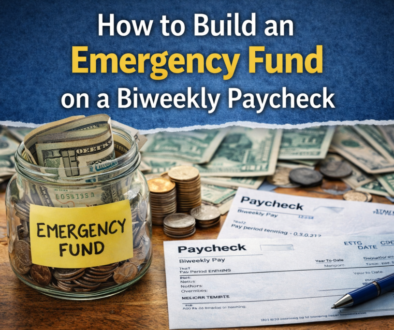
- paid biweekly: save $100 to $250 each check
- paid monthly: save $250 to $500 each check
This does not have to get you to $1,000 on its own. It just creates a reliable base while you add faster wins on top.
Step 6: Use a “stacked” savings plan
The fastest realistic way to save your first $1,000 is not one giant sacrifice. It is a stacked plan made of several smaller moves.
A strong example might look like this:
- cancel or pause subscriptions: $40
- cut two weeks of takeout: $80
- reduce grocery overspending: $60
- transfer automatically from paycheck: $200
- sell unused items: $150
- redirect a side gig or extra shift: $250
- trim a recurring bill: $40
- move leftover checking balance at month-end: $100
- total: $920
Then one more small move, like a lighter weekend or one extra transfer, pushes you over $1,000.
This works better than extreme budgeting because it spreads the pressure across different sources instead of asking one area of your life to do all the work.
Step 7: Sell what you are not using
If your goal is to save your first $1,000 fast, selling unused items is one of the highest-speed options.
Look for:
- old electronics
- unused kitchen appliances
- extra furniture
- clothes in excellent condition
- sports or hobby gear
- baby items no longer needed
This is not a long-term plan, but it is an excellent short-term accelerant. It creates a fast cash injection without forcing you to squeeze every dollar out of your monthly budget.
Step 8: Use short-term income boosts, not permanent burnout
There is nothing wrong with using a short-term push to reach your first emergency-fund milestone. The key is to keep it temporary.
Examples:
- one extra shift a week for a month
- a freelance project
- weekend delivery work for a short period
- pet sitting, tutoring, or task-based work
- selling a skill you already have
The goal is not to build your whole life around hustle. The goal is to speed up the first $1,000 so your budget has breathing room sooner.
Step 9: Protect your budget while you save
This part matters more than most people realize.
You are not trying to save $1,000 by creating a budget so harsh that you quit after ten days. The point is to build a buffer without wrecking your normal life.
That means:
- do not underbudget essentials
- do not skip bills to save
- do not create credit-card debt just to “hit the goal”
- do not treat one hard week as failure
The Federal Reserve’s data shows that many households are still balancing rising expenses with limited room in the budget. A savings plan only works if it can survive real life.
A better mindset is:
- trim waste hard
- keep essentials realistic
- automate progress
- let consistency do most of the work
Step 10: Keep the first $1,000 where you cannot casually touch it
Once you hit your first $1,000, do not let it drift back into checking. Leave it in a separate emergency savings account and treat it like the start of your financial safety net.
The CFPB says emergency savings should ideally be kept in an easily accessible account and recommends maintaining them in a dedicated account. That makes it much easier to preserve the money for real emergencies instead of routine spending.
A simple 30-day plan to save your first $1,000 fast
Here is a realistic example:
Week 1
- open separate savings account
- move first $100
- cancel 2–3 unused subscriptions
- sell one unused item
Week 2
- automatic transfer from paycheck
- reduce takeout and convenience spending
- move grocery savings to fund
Week 3
- review recurring bills
- do one side-income push or extra shift
- transfer another lump sum
Week 4
- sweep leftover checking balance
- sell a few more items
- top off the gap to reach $1,000
This kind of plan is fast because it combines behavior change, automation, and quick wins.
Final answer: how to save your first $1,000 fast
The fastest way to save your first $1,000 is to:
- open a separate emergency savings account
- automate transfers from every paycheck
- cut the easiest waste first
- add a few quick cash sources like selling items or short-term extra income
- protect your normal budget so the plan stays realistic
Your first $1,000 is not the end goal. It is the beginning of financial breathing room. The CFPB says even small emergency savings can improve financial security, and Federal Reserve data shows millions of households are still vulnerable to relatively modest surprise expenses. That is exactly why this first milestone matters so much.
FAQ
Is $1,000 enough for an emergency fund?
It is a strong starter emergency fund, but not a fully funded one for most households. It can handle smaller financial shocks and reduce your need to borrow.
How fast can I save my first $1,000?
That depends on your income, current expenses, and how aggressive you want to be. Many people can do it in 30 to 90 days with a mix of automation, spending cuts, and short-term extra income.
Should I pay off debt or save my first $1,000 first?
For many households, building a small starter emergency fund first is useful because it reduces the odds that every surprise expense turns into new debt. The CFPB emphasizes that even small emergency savings can improve security.
Where should I keep my first $1,000?
Usually in a separate savings account at an insured bank or federally insured credit union, not in everyday checking. The CFPB recommends a dedicated account for emergency funds.
What should I do after I save the first $1,000?
Your next step is usually to build toward one month of essential expenses, then eventually toward a larger emergency fund based on your household risk and needs.